18
Jun
Templer Run has bright graphics and fun, addicting gameplay that lets players feel the thrill of avoiding obstacles in a never-ending run.
Templer Run has bright graphics and fun, addicting gameplay that lets players feel the thrill of avoiding obstacles in a never-ending run.
[…] to the plan elaborated by Morgan, the proposed settlement agreement was signed by Ripple on April 23, 2025. The SEC signed its side of the deal on May 8. Both entities […]
An article that makes people unable to calm down, ignites a flame in their hearts, and generates strong hope. My life has never been ordinary!
I am brand new to crypto. And with the abundance of knowledge out thereof,I have been trying to learn. It is all a bit overwhelming I must admit. I need all the help I can get. How to mine Bitcoin, for free wherever I can. Where to invest when I start getting a paycheck. (I just got out of jail) How to get paid the fastest, and long term.
[…] Rodriguez-Alarcón identifies two dominant factors behind the latest crypto market pullback. He explains that the unfolding tensions have pushed institutional capital into […]
Today we’re introducing a new way to earn up to 8% annually on your Bitcoin (BTC): Active Rewards.
For those who have a market view on where the price of Bitcoin will go, Active Rewards can be used to maximize your potential rewards at up to 10x the rate of Passive Rewards (formerly “Rewards”).
Active Rewards provides a way for you to earn on your Bitcoin in an otherwise down or flat market. Specifically, it lets you subscribe to a strategy to earn rewards if you believe the price of Bitcoin won’t go up significantly in the next week.
It could offer a significantly higher rewards rate on Bitcoin than Passive Rewards (up to 8% annually vs up to 0.65% annually, at current rates as of April 2023. To view live rates visit our website).
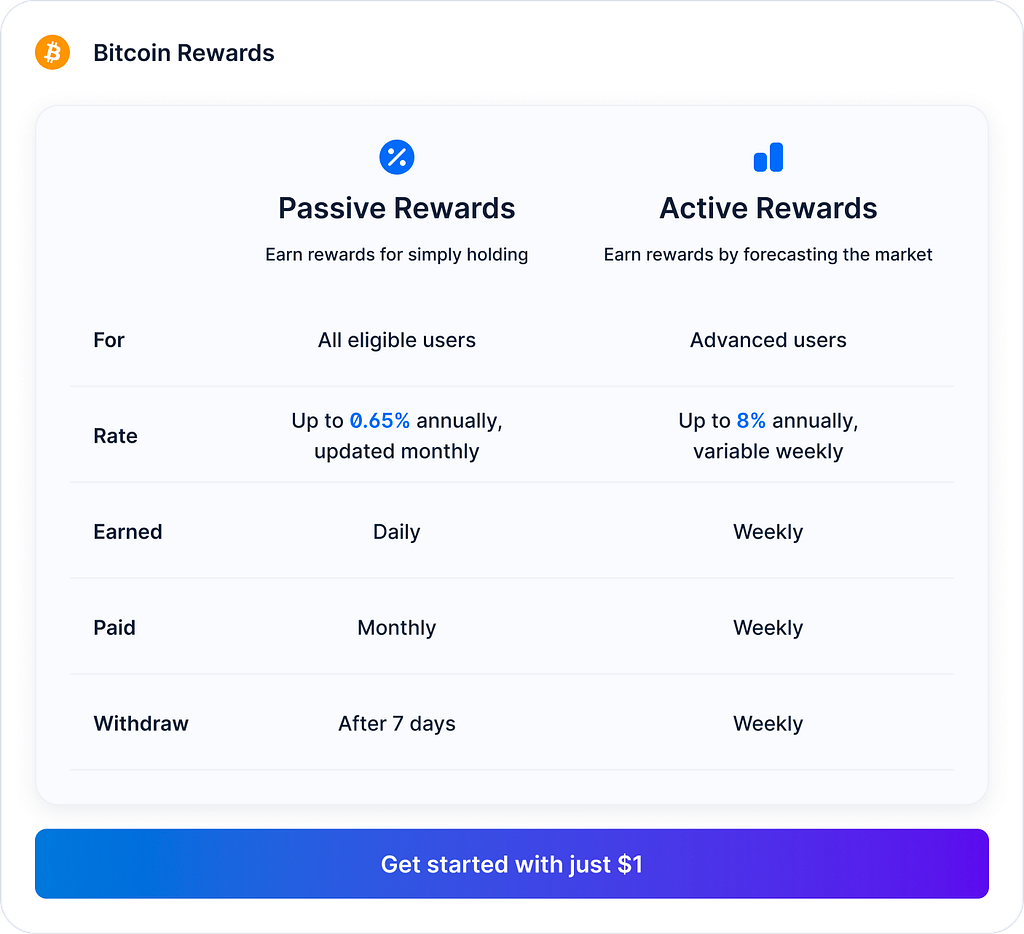
Every week, a new Active Rewards strategy is made available to all Active Rewards customers that sets a trigger price for Bitcoin that is higher than the current market price. If you believe the price will be under the trigger price at the end of the week, subscribe to the strategy and earn an annual rewards rate on your Bitcoin, paid out weekly on Fridays at 8am UTC.
The trigger price and the rewards rate are set at the start of each weekly cycle and if you don’t withdraw your funds you’ll automatically be rolled into the strategy for the following week.
Since the specific trigger price changes each week, let’s take a look at some scenarios using the following values:
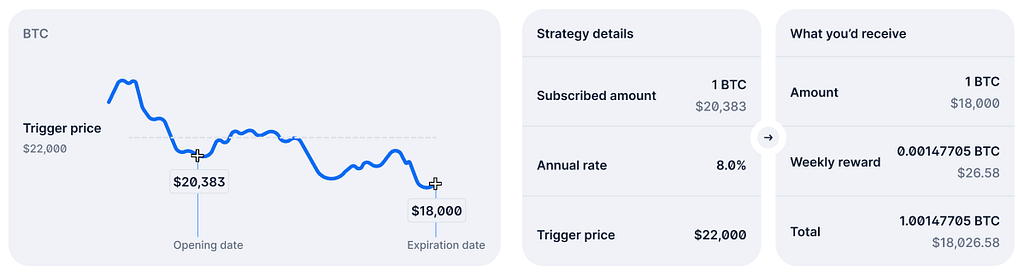
Scenario 1 — Price of Bitcoin is at or lower than the trigger price at the end of the week
If the price of Bitcoin ends the week at or lower than the trigger price, you’ll receive your rewards for the week and your Bitcoin will be returned to you valued at the market price.
So in the scenario depicted below, if you start the week by depositing 1 Bitcoin in Active Rewards, you’d end the week with 1.00147705 which would then be re-subscribed to earn rewards for the following week.
Scenario 2 — Price of Bitcoin is higher than the trigger price at the end of the week
If the price of Bitcoin ends the week higher than the trigger price, you’ll still receive your rewards for the week but your Bitcoin will be returned to you valued at the trigger price, resulting in a reduction in your Bitcoin-denominated balance.
So in the scenario depicted below, you’d start the week with 1 Bitcoin, at the end of the week you’d receive your 0.00147705 Bitcoin reward, but because the price of Bitcoin went over the trigger price your Bitcoin balance would go down from 1 to 0.88147705 Bitcoin. Thus, you’d have a balance of 0.88147705 Bitcoin which would be re-subscribed to earn rewards for the following week.
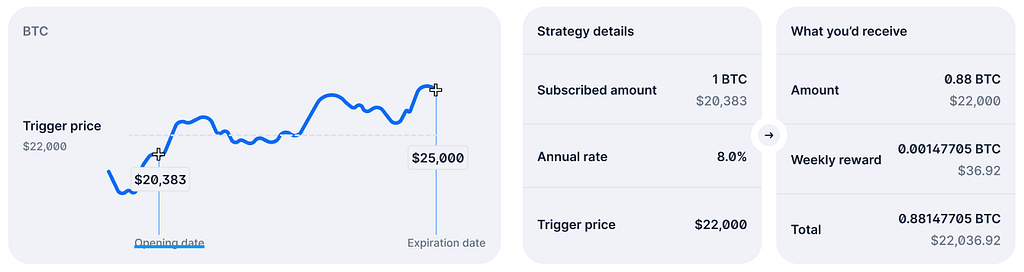
While Active Rewards offers compelling weekly rewards on your Bitcoin, weekly market movements above the listed trigger price can reduce your Bitcoin-denominated balance.
You can get started by transferring as little as $1 in Bitcoin to an Active Rewards Account:
Note: Active Rewards is not available in all countries. You can check your eligibility here.
IMPORTANT NOTE:
The purchase of crypto entails a risk. The value of crypto can fluctuate and capital involved in a crypto transaction is subject to market volatility and loss.
Digital currencies are not bank deposits and are not legal tender. Blockchain.com’s products and services are not subject to any governmental or government-backed deposit protection schemes. Legislative and regulatory changes or actions in any jurisdiction in which Blockchain.com’s customers are located may adversely affect the use, transfer, exchange, and value of digital currencies.

Earn up to 8% annually on Bitcoin with Active Rewards was originally published in @blockchain on Medium, where people are continuing the conversation by highlighting and responding to this story.
This month, Ethereum will undergo the “Shanghai-Capella” upgrade, the largest network upgrade since the “Ethereum Merge” in 2022.
“Shanghai-Capella” will enable the withdrawal of staked ETH from the Ethereum blockchain, completing its transition from a proof of work to a proof of stake network.
The upgrade promises to usher in a new era of scalability, sustainability and mainstream adoption for Ethereum, but what does it mean for everyday users of Ethereum? Find out below:
While the upgrade is a huge advance forward for those who stake and the Ethereum network at large, the upgrade will have little impact upon how everyday users interact with Ethereum or the economics of the network itself.
You can track the Ethereum #ShanghaiCapellaUpgrade on the Blockchain.com Explorer
Blockchain Explorer – Ethereum Shanghai Upgrade | Blockchain.com
The Ethereum Upgrade: Everything You Need to Know About Shanghai-Capella was originally published in @blockchain on Medium, where people are continuing the conversation by highlighting and responding to this story.
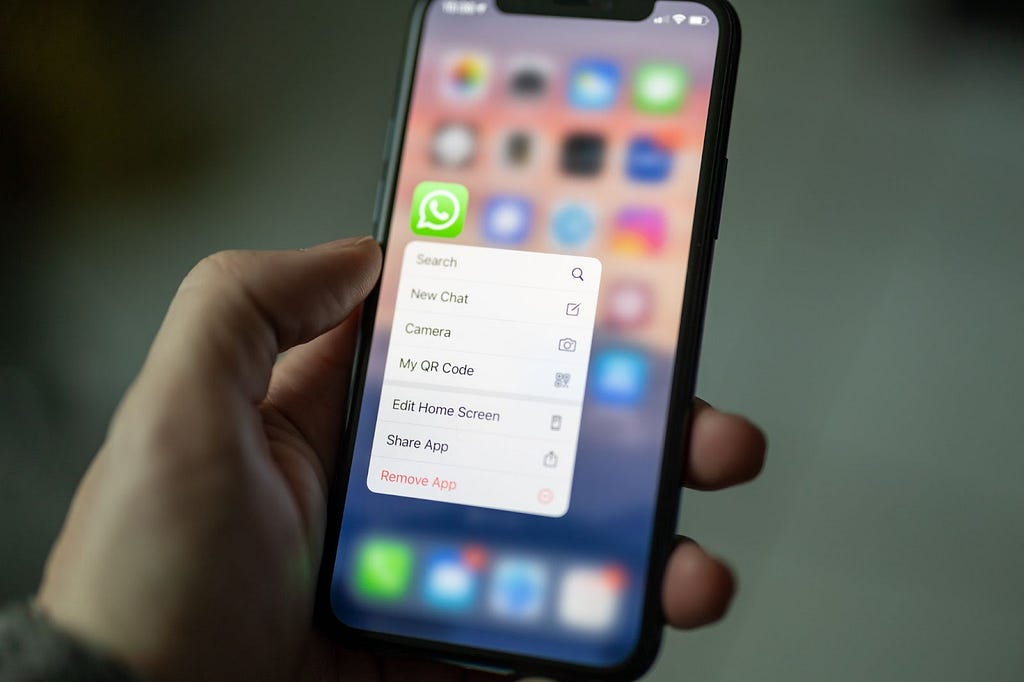
Our Crypto IRL series showcases individuals who are leading the charge in the crypto revolution by using cryptocurrency in real life to drive financial inclusivity, enterprise, and innovation.
We’re excited to share a recent conversation we had with Bernardo Garcia, Co-Founder of Félix Pago, the world’s first chat-bot on WhatsApp that allows Latino immigrants in the US to send remittances abroad.
Félix Pago leverages blockchain and AI to make remittances as simple and fast as sending a message.
Félix Pago serves hard working foreign born Latino immigrants that live in the US and provide support to their family members that stayed in their home country. We leverage blockchain and AI to make remittances as simple and fast as sending a WhatsApp message.
Félix was built to meet Latino’s where they are, on WhatsApp, and to help them save time and money when they take care of their loved ones.
Félix leverages stable coins to get the customer’s funds from the US to Mexico.
First, the customer sees a guaranteed exchange rate of USD/MXN in the Félix chat. Once they pay, Félix takes the funds, converts them into stable coins, and then executes the necessary trades in crypto to get the Mexican pesos in the hands of the customer’s beneficiary in real time.
The main benefits of using crypto are the speed of the transactions and the low costs.
Doing a cross-border transaction via traditional rails, like swift, takes days and is very expensive, which makes it inefficient.
We believe that the future of crypto is when it powers our day to day lives and we don’t even notice it! That’s what Félix is all about.
In the end, what matters to us and our customers is that the funds get from A to B in real time at the lowest possible cost.
Do you have an example to share of how cryptocurrency is being used IRL? Tweet us! @blockchain
This information is provided for informational purposes only and is not intended to substitute for obtaining accounting, tax or financial advice from a professional advisor. The views, information, or opinions expressed during the Crypto IRL series are solely those of the individuals involved and do not necessarily represent those of Blockchain.com and its employees.
Crypto IRL: Crypto Remittance Sent via WhatsApp was originally published in @blockchain on Medium, where people are continuing the conversation by highlighting and responding to this story.
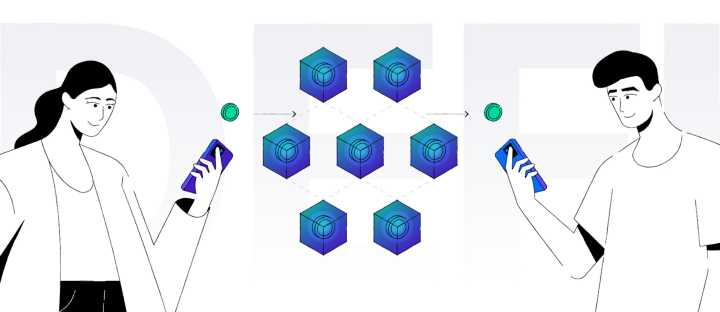
Bitcoin has a frequently cited problem–scalability.
The Bitcoin network can only handle a certain number of transactions at once, making it take a long time for transactions to go through and impacting the price of fees.
One of the leading causes of the scalability problem is that each transaction must be verified by every node in the network, which requires a lot of computational power and bandwidth.
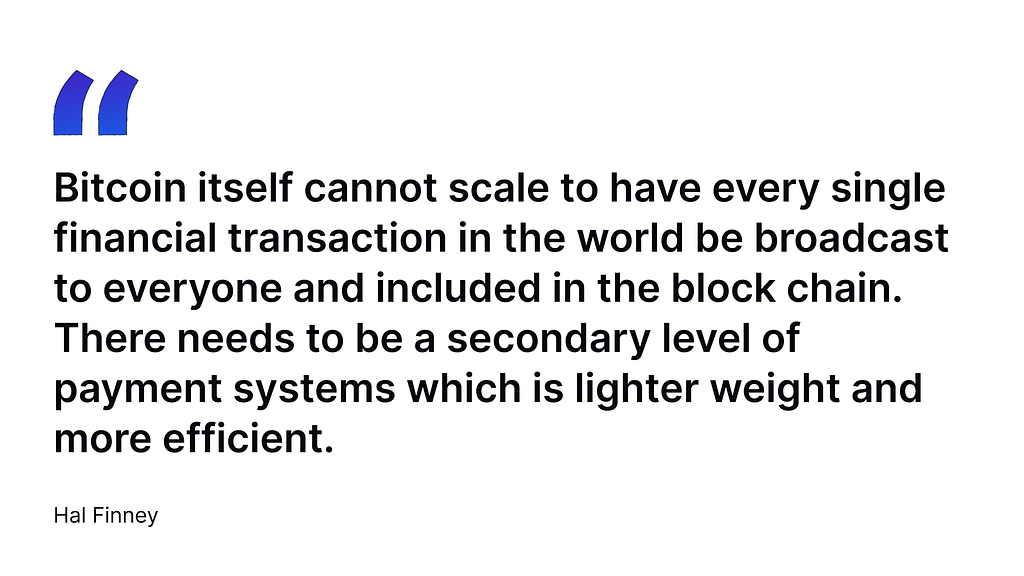
The Bitcoin network, as it exists now, can’t function as a payments system at a large scale, and it was never meant to.
As a Layer 1 system, the core Bitcoin blockchain serves its purpose as intended: it’s a decentralized, immutable ledger system.
Part of Bitcoin’s store of value comes from the energy required from the Proof of Work consensus mechanism it uses, but this doesn’t translate well to being used as a globally adopted medium of exchange.
Enter, the Lightning Network.
The Lightning Network was designed to improve the speed and efficiency of transactions on the Bitcoin network by allowing users to make transactions off-chain without the need for block confirmation on the blockchain.
This can help to reduce transaction fees and improve the overall scalability of the network.
The Lightning Network is a Layer 2 protocol that allows users to create payment channels on the Bitcoin network.
The Lightning Network white paper was written in 2016 by Joseph Poon and Thaddeus Dryja, and has been in active development ever since.
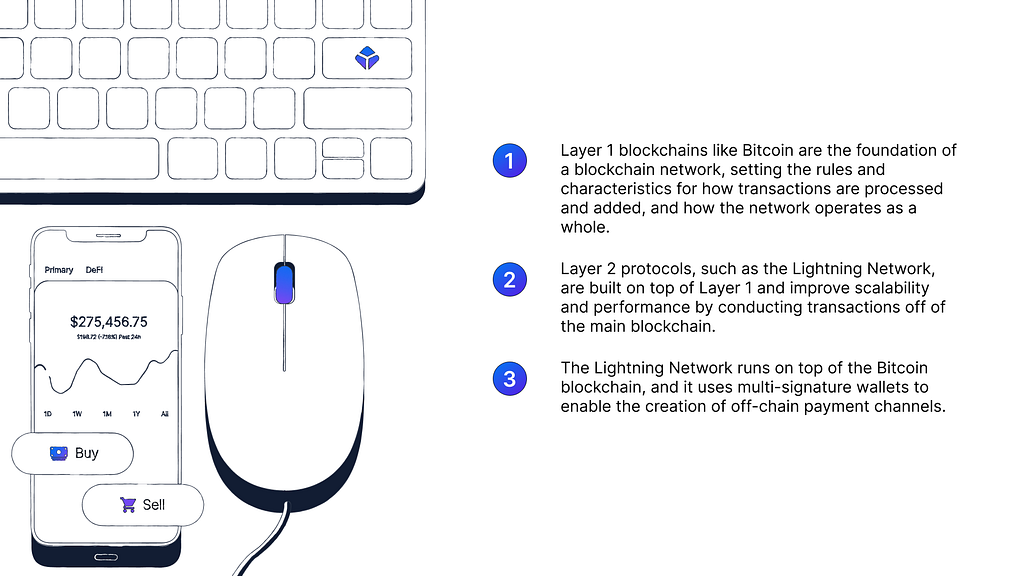
The Lightning Network runs on top of the Bitcoin blockchain, and it uses multi-signature wallets to enable the creation of off-chain payment channels.
This allows for faster, cheaper transactions and the ability to make transactions without waiting for block confirmation on the blockchain.
The Lightning Network allows for the creation of payment channels between users on the Bitcoin network.
These channels can be thought of as a way for two users to make an unlimited number of transactions with each other without having to wait for block confirmation on the blockchain.
You might wonder why this is even necessary, and the reason is simple–scalability. If you’ve ever tried to send a small transaction through the Bitcoin network, you know that it can be slow and expensive.
Here’s why:
As you can see, this limits the ability to use BTC for micro-transactions.
If you tried to use BTC to pay for your $30 dinner, you could potentially pay an equal amount in fees to process that transaction, plus it would take at least ten minutes for the restaurant to process the purchase.
Compare this with a payment processor like Visa, which can handle around 65,000 transactions per second with nominal fees, and it becomes clear that another solution is needed to make BTC a true medium of exchange.
The Lightning Network solves this using payment channels, a way for bitcoin to be exchanged between users off-chain, or outside of the core blockchain. Users can transact with each other as much as they want, and close a payment channel when they’re done transacting.
The only transactions that are added to the Layer 1 blockchain are the opening (funding) transaction and the closing (settlement) transaction.
Because of this, it’s possible that the Lightning Network could process up to 1 million transactions per second.
To create a payment channel, two users must deposit some bitcoin into a multi-signature wallet on the Lightning Network.
This creates a “channel” between the two users, which can be used for any number of transactions.
Once the channel is created, the users can make transactions with each other by updating the smart contract with the new balance. Both parties sign any updates, but they’re only broadcast to the network once the channel is closed.
When the channel closes, the final state of the smart contract is broadcast to the Bitcoin network, and the appropriate amounts of bitcoin are transferred to the users’ wallets. This allows for off-chain transactions to be made quickly and without the need for block confirmation, which can significantly improve the speed and efficiency of the network.
The Lightning Network also allows for the creation of multi-hop payment channels, where a user can make a payment to another user through a series of intermediate channels, which in this case is other users on the network. This can further increase the flexibility and scalability of the network.
Using intermediaries is where the Lightning Network really shines, since it further scales payment options.
Here’s how it works:
In this simplified example, there are three people who all use the Lightning Network.
User A and User B have an open payment channel, and User B also has an open payment channel with User C. Users A and C do not have a payment channel established, but they can transact with each other through User B.
No additional payment channel was needed, and the individual off-chain ledgers were all updated throughout the process.

For the most part, the Lightning Network is a decentralized protocol. This means that the Lightning Network is not controlled by any single entity but relies on a distributed network of users.
The decentralized nature of the Lightning Network allows users to make transactions directly with each other without the need for custodians, like a bank or centralized payment processor. This can help to reduce transaction fees and improve the overall speed and efficiency of the network.
There are several benefits to using the Lightning Network for transactions on the Bitcoin network, including:
The Lightning Network has the potential to significantly improve the speed, efficiency, and scalability of the Bitcoin network.
While it’s still in the early stages of development, it has the potential to become an influential part of the Bitcoin ecosystem.
As a relatively new technology, the Lightning Network may face some challenges and potential problems. Some of the key challenges and potential issues with the Lightning Network include the following:
These challenges and risks should be considered before using the Lightning Network.
The Lightning Network has the potential to be an indispensable part of the Bitcoin ecosystem, but you don’t need to use the Lightning Network to start buying BTC.
Create a Blockchain.com Account today and make your first bitcoin purchase!
Important Note
This information is provided for informational purposes only and is not intended to substitute for obtaining accounting, tax or financial advice from a professional advisor.
The purchase of crypto entails risk. The value of crypto can fluctuate and capital involved in a crypto transaction is subject to market volatility and loss.
Digital currencies are not bank deposits, are not legal tender, and are not backed by the government. Blockchain.com’s products and services are not subject to any governmental or government-backed deposit protection schemes.
Legislative and regulatory changes or actions in any jurisdiction in which Blockchain.com’s customers are located may adversely affect the use, transfer, exchange, and value of digital currencies.
The Lightning Network, Explained was originally published in @blockchain on Medium, where people are continuing the conversation by highlighting and responding to this story.

We’re already a few weeks into tax season! For many people with complicated returns, tax prep started well before January. But even if your situation is fairly simple, you would still need to gather documents, review your finances, and account for any big changes that may have happened over the past year.
Are you ready for tax season? What documents do you still need, if any? Are you filing your own taxes or hiring someone to do it?
Tell us whether you’re ready for tax season and we’ll enter you in a drawing to win a $20 Amazon Gift Card!
We’re doing three giveaways — here’s how you can win:
Use our Rafflecopter widget for your chance to win one of three Amazon Gift Cards:
Good Luck!