Month: January 2026

About Sterling Brasher

Full Name: Sterling Brasher

Designation: Product Owner/Treasury Management Consultant

Company: FIS

Country: United States

Sterling’s Learning Journey That Inspires

Which 101 Blockchains Course(s)/Certification(s) did you complete?

I have successfully earned the Certified Fintech Expert (CFTE)™ credential from 101 Blockchains.

Why did you choose this program, and how was your overall learning experience with 101 Blockchains?

I chose the CFTE certification from 101 Blockchains because, working in treasury and fintech, I see how digital technology is changing the way we operate. I wanted more than just high-level concepts or trends; I was looking for a program built on solid business cases with skills I could apply right away, especially in payments and risk management. 101 Blockchains had a good reputation and their approach felt practical—clear lessons, up-to-date examples, and ways to translate blockchain ideas into what actually matters for modern finance teams.​

The learning experience didn’t disappoint. The structure made it easy to follow, even with a busy schedule, and the modules were relevant to what I do every day. There wasn’t any fluff; each section gave me something useful to take back and use in strategy sessions or new projects at work. The mix of technical foundation and real-world cases kept the content accessible, and the support throughout the program was reliable. I finished the certification feeling more confident using blockchain concepts in treasury and fintech—and I would certainly recommend it to anyone ready to keep up with the pace of change in the industry!

At 101 Blockchains, you don’t just earn certifications — you gain real-world skills that shape you into a confident blockchain professional.

What skills or knowledge did you gain that helped you most?

The CFTE certification helped me build a much stronger understanding of what blockchain and digital assets actually do in financial services—and how to apply these tools in real business situations, not just talk about the buzzwords. I learned how to break down key concepts like decentralization and smart contracts so they’re useful in daily work with payments or risk teams, and got a handle on the regulatory and compliance side, which is critical for treasury and fintech strategy.

I’d say the biggest skills I picked up were:

  • Translating blockchain mechanics and digital asset workflows into practical solutions—especially for payments modernization, tokenization, digital currencies, and risk frameworks.
  • Making sense of global trends, regulatory changes, and how institutions are really using blockchain—insights that help with planning and strategy, not just technical conversations.
  • Hands-on knowledge about new business models, compliance, digital identity, and even cybersecurity tied to blockchain environments.

Overall, the course made technical ideas much more applicable for solving actual challenges in treasury and fintech—and helped me gain tools I now use in everything from designing new products to advising on digital transformation projects.

How has this program contributed to your professional growth?

This program has made a real impact on my professional growth by bridging the gap between emerging fintech trends—like blockchain, digital assets, and CBDCs—and what I actually do day-to-day in treasury and strategy roles. It’s given me a solid grasp of how modern payments, regulations, and new business models are evolving, so I’m able to guide my teams and clients with more confidence and clarity.

The CFTE certification opened new doors by validating my skills in areas that matter for the future of finance, whether that’s implementing tokenization, advising on compliance, or streamlining digital identity processes. It’s helped me stand out in conversations about innovation and digital transformation, and given me the tools to stay ahead of changes in the market instead of just reacting to them.

Overall, the program elevated my ability to lead and make decisions, making me a better resource for organizations pushing into fintech and blockchain—and helping me keep my career on an upward track as the industry evolves.

From learners to leaders — explore the success stories of 100,000+ professionals with 101 Blockchains.

What advice would you give to someone considering a career in blockchain?

Even though my current role doesn’t involve blockchain on a daily basis, I’ve noticed that much of the foundation of finance is rapidly adapting to it—whether that’s through payments, security, compliance, or digital assets. That’s why I believe it’s essential to learn and understand blockchain, regardless of your current position. It’s become a core layer of innovation in finance and tech, making it a valuable skill set for anyone looking to stay relevant.

For those considering a career in blockchain, start by gaining a clear understanding of how it’s reshaping business models and financial services. Even roles outside of coding or pure tech benefit from blockchain knowledge, as many traditional finance jobs now intersect with these new technologies. By staying proactive and learning about blockchain, you’ll be ready to adapt as the industry shifts, and you’ll open up new possibilities for growth whether you’re working in operations, strategy, compliance, or product innovation.

Unlock your career with 101 Blockchains' Learning Programs

The post Success Story: Sterling Brasher’s Learning Journey with 101 Blockchains appeared first on 101 Blockchains.

Artificial intelligence is a formidable force that drives the modern technological landscape without being limited to research labs. You can find multiple use cases of AI across industries albeit with a limitation. The rising use of artificial intelligence has called for attention to AI security risks that create setbacks for AI adoption. Sophisticated AI systems can yield biased results or end up as threats to security and privacy of users. Understanding the most prominent security risks for artificial intelligence and techniques to mitigate them will provide safer approaches to embrace AI applications.

Unraveling the Significance of AI Security 

Did you know that AI security is a separate discipline that has been gaining traction among companies adopting artificial intelligence? AI security involves safeguarding AI systems from risks that could directly affect their behavior and expose sensitive data. Artificial intelligence models learn from data and feedback they receive and evolve accordingly, which makes them more dynamic. 

The dynamic nature of artificial intelligence is one of the reasons for which security risks of AI can emerge from anywhere. You may never know how manipulated inputs or poisoned data will affect the internal working of AI models. Vulnerabilities in AI systems can emerge at any point in the lifecycle of AI systems from development to real-world applications.

The growing adoption of artificial intelligence calls for attention to AI security as one of the focal points in discussions around cybersecurity. Comprehensive awareness of potential risks to AI security and proactive risk management strategies can help you keep AI systems safe.

Want to understand the importance of ethics in AI, ethical frameworks, principles, and challenges? Enroll now in the Ethics Of Artificial Intelligence (AI) Course!

Identifying the Common AI Security Risks and Their Solution

Artificial intelligence systems can always come up with new ways in which things could go wrong. The problem of AI cyber security risks emerges from the fact that AI systems not only run code but also learn from data and feedback. It creates the perfect recipe for attacks that directly target the training, behavior and output of AI models. An overview of the common security risks for artificial intelligence will help you understand the strategies required to fight them.

  • Adversarial Attacks

Many people believe that AI models understand data exactly like humans. On the contrary, the learning process of artificial intelligence models is significantly different and can be a huge vulnerability. Attackers can feed crafted inputs to AI models and force it to make incorrect or irrelevant decisions. These types of attacks, known as adversarial attacks, directly affect how an AI model thinks. Attackers can use adversarial attacks to slip past security safeguards and corrupt the integrity of artificial intelligence systems.

The ideal approaches for resolving such security risks involve exposing a model to different types of perturbation techniques during training. In addition, you must also use ensemble architectures that help in reducing the chances of a single weakness inflicting catastrophic damage. Red-team stress tests that simulate real-world adversarial tricks should be mandatory before releasing the model to production.

  • Leaks in Training Data

Artificial intelligence models can unintentionally expose sensitive records in their training data. The search for answers to “What are the security risks of AI?” reveals that exposure of training data can affect the output of models. For example, customer support chatbots can expose the email threads of real customers. As a result, companies can end up with regulatory fines, privacy lawsuits, and loss of user trust.

The risk of exposing sensitive training data can be managed with a layered approach rather than relying on specific solutions. You can avoid training data leakage by infusing differential privacy in the training pipeline to safeguard individual records. It is also important to exchange real data with high-fidelity synthetic datasets and strip out any personally identifiable information. The other promising solutions for training data leakage include setting up continuous monitoring for leakage patterns and deploying guardrails to block leakage.      

  • Poisoned AI Models and Data

The impact of security risks in artificial intelligence is also evident in how manipulated training data can affect the integrity of AI models. Businesses that follow AI security best practices comply with essential guidelines to ensure safety from such attacks. Without safeguards against data and model poisoning, businesses may end up with bigger losses like incorrect decisions, data breaches, and operational failures. For example, the training data used for an AI-powered spam filter can be compromised, thereby leading to classification of legitimate emails as spam.

You must adopt a multi-layered strategy to combat such attacks on artificial intelligence security. One of the most effective methods to deal with data and model poisoning is validation of data sources through cryptographic signing. Behavioral AI detection can help in flagging anomalies in the behavior of AI models and you can support it with automated anomaly detection systems. Businesses can also deploy continuous model drift monitoring to track changes in performance emerging from poisoned data.

Unlock your potential with the Certified AI Professional (CAIP)™ Certification. Gain expert-led training and the skills to excel in today’s AI-driven world.

  • Synthetic Media and Deepfakes

Have you come across news headlines where deepfakes and AI-generated videos were used to commit fraud? The examples of such incidents create negative sentiment around artificial intelligence and can deteriorate trust in AI solutions. Attackers can impersonate executives and provide approval for wire transfers through bypassing approval workflows.

You can implement an AI security system to fight against such security risks with verification protocols for validating identity through different channels. The solutions for identity validation may include multi-factor authentication in approval workflows and face-to-face video challenges. Security systems for synthetic media can also implement correlation of voice request anomalies with end user behavior to automatically isolate hosts after detecting threats.

  • Biases in Training Data

One of the most critical threats to AI security that goes unnoticed is the possibility of biased training data. The impact of biases in training data can go to an extent where AI-powered security models cannot anticipate threats directly. For example, fraud-detection systems trained for domestic transactions could miss the anomalous patterns evident in international transactions. On the other hand, AI models with biased training data may flag benign activities repeatedly while ignoring malicious behaviors.

The proven and tested solution to such AI security risks involves comprehensive data audits. You have to run periodic data assessments and evaluate the fairness of AI models to compare their precision and recall across different environments. It is also important to incorporate human oversight in data audits and test model performance in all areas before deploying the model to production.

Excited to learn the fundamentals of AI applications in business? Enroll now in AI For Business Course

Final Thoughts 

The distinct security challenges for artificial intelligence systems create significant troubles for broader adoption of AI systems. Businesses that embrace artificial intelligence must be prepared for the security risks of AI and implement relevant mitigation strategies. Awareness of the most common security risks helps in safeguarding AI systems from imminent damage and protecting them from emerging threats. Learn more about artificial intelligence security and how it can help businesses right now.

Unlock your career with 101 Blockchains' Learning Programs

The post Common Security Risks in AI Systems — and How to Prevent Them appeared first on 101 Blockchains.

Businesses all over the world have been exploring new use cases of blockchain to streamline their operations, gain the trust of customers and enhance asset security. Is blockchain security in business applications a reality or myth? Many people believe that the design of blockchain may invite a lot of risks, such as decentralization empowering a larger base of users.

The real-world use cases of blockchain paint a completely different picture. If you get blockchain security right, then you couldn’t find a better choice than blockchain for industries like healthcare and finance. This is where you can notice why business leaders must learn about blockchain security and the risks of blockchain adoption. 

Certified blockchain security expert

Can You Trust Blockchain Security in Business Use Cases?

Blockchain is gradually becoming the top priority for businesses looking at opportunities for digital transformation with assurance of long-term benefits. You can search for answers to “What is the use of blockchain in business?” and find different advantages in the business use cases of blockchain. Most of the applications developed before the arrival of blockchain were not shaped to withstand major attacks. On the contrary, blockchain was intrinsically tailored to incorporate security in its design.

  • Immutability of Transactions

Any transaction recorded on a blockchain stays there forever and no one can modify the transaction details. The trait of immutability ensures that all transaction records of a business locked on a blockchain are tamper-proof.

  • Resilience with Decentralization

Decentralization is one of the distinct elements in the design of blockchain that makes it more secure than conventional technologies. With the power of decentralization, blockchain eliminates single points of failure and enhances resilience. Attackers cannot compromise blockchain security by breaking into one or two nodes in the network.

  • Cryptographic Blockchain Security in Business Applications

Another notable detail about blockchain security draws the limelight towards cryptographic encryption. Businesses can have the assurance of cryptographic security for their assets and sensitive information on blockchain networks.

The best practices to leverage blockchain for data security, when implemented correctly, can provide the guarantee for unparalleled security in business applications. Business leaders must know about blockchain architecture and the implications of security in different architecture types to achieve stronger safeguards.

How Does Blockchain Architecture Determine Security?

According to Forbes, hackers made away with more than $3 billion in the first half of 2025 (Source). This definitely raises some questions about blockchain security and whether your business should adopt blockchain technology

Business leaders may believe that decentralization, cryptography, and immutability are enough to ensure security. Blockchain is supposed to be secure by design and not completely invulnerable. It is also important to understand that the type of blockchain architecture you choose for business applications plays a major role in security. 

The strength of blockchain security also depends on governance mechanisms and implementation of different architectures. Every business leader must first decide whether they want to use public or private blockchain architecture for their business. You can find distinct benefits and challenges with both types of blockchain architecture.

  • Public Blockchain Architecture

Public blockchain, as the name implies, offers the right to anyone with the native token to participate in the network. You must have heard about the top public blockchains like Ethereum and Solana. The introduction to blockchain security in public blockchains focuses on decentralized consensus mechanisms and cryptographic integrity. Public blockchain networks validate transactions through consensus among independent nodes and with enough number of trusted validators; businesses can avoid single points of failure.

Businesses can also rely on public blockchains for complete transparency into transaction details and tamper-proof data integrity. On top of it, decentralization prevents the concerns of censorship or internal fraud while increasing resilience. It is also important to note that gaining control over a majority of public blockchain networks is practically impossible.  

Despite the inherent advantages for blockchain security, public blockchains are not completely flawless. Smart contracts with vulnerabilities, when executed on a public blockchain, create more possibilities for exploits. Public blockchains may also pose security risks due to issues in complying with the security standards your business follows, new privacy laws and regulatory requirements.

  • Private Blockchain Architecture

If you think that public blockchain architecture is not suitable for your business, then you might choose private blockchain. Any business leader who understands the importance of blockchain security in business is likely to think about private blockchains as an ideal solution. Private blockchain networks offer the benefits of cryptographic security and decentralized consensus to ensure better security.

You will also find many other advantages for security with private blockchain protocols. One of the distinct traits of private blockchains is that they offer limited access only to verified participants. As a result, you can overcome any compliance issues and follow enterprise security standards and industry regulations. Private blockchains also open the doors for implementing unique encryption methods and custom governance policies.    

The private blockchain architecture may seem more secure than public blockchains. However, a private blockchain offers a more centralized architecture that places the responsibility of security on few selected participants. The centralization in private blockchain architecture also reduces its resilience and creates vulnerabilities to internal attacks.

Unlock new career opportunities in Web3 security with our Certified Web3 Hacker (CW3H)™—your gateway to mastering ethical hacking in the decentralized world

How Can Leaders Enhance Blockchain Security in Business?

The big question for every business leader, beyond choosing the blockchain architecture, revolves around ways to improve blockchain security. Business owners and decision-makers must know that adopting blockchain for data security requires a complex and layered approach to security. You should identify the most notable security challenges associated with blockchain and the best practices for resolving them.

  • Resolve Smart Contract Vulnerabilities

You can pick any guide on blockchain security and find how smart contracts are the weakest link in blockchain infrastructure. Smart contract vulnerabilities must be addressed from the roots by following the best practices for smart contract coding. Formal verification for validating smart contract logic and third-party code audits can help you identify smart contract vulnerabilities earlier. Businesses should also offer bug bounties to identify security flaws before they cause any damage.

  • Managing the Security and Scalability Balance

The blockchain trilemma leads many businesses to trade-off security for higher transaction volumes and vice-versa. You can strengthen blockchain security in business without sacrificing scalability by adopting novel solutions like multi-chain architecture. In addition, adaptive security models that can adjust according to the growing transaction volume can help in mitigating security risks. Furthermore, adoption of more efficient consensus mechanisms can help businesses achieve the perfect balance between security and scalability.

  • Resolving Security Threats from the Inside

Blockchain security is not all about cryptographic security as insider threats and governance risks may also put blockchain systems at risk. Business leaders should adopt decentralized governance models to prevent control slipping away into the hands of few actors. Frequent transparent audits can help in uncovering insider threats and strengthen the security of on-chain governance mechanisms.

Step into the Web3 Security Expert Career Path and build the skills to secure blockchain and decentralized systems

Final Thoughts 

The ability to understand the importance of blockchain security in business applications is the first step to achieve blockchain security. As blockchain adoption gains momentum across different industries, business leaders must know which blockchain architecture is safer for their business. Every business leader must also familiarize with best practices to enhance blockchain security.

The Certified Blockchain Security Expert (CBSE)™ certification course by 101 Blockchains is one of the most comprehensive training programs on blockchain security. It offers in-depth explanation of different blockchain security threats and best practices to identify security risks. Pick the best resources to learn more about blockchain security and tap into the full potential of blockchain technology now.

The post Blockchain Security Basics for Business Leaders appeared first on 101 Blockchains.

e-wasteJack Cartwright, Innovent Recycling, explores the substantial material value hidden in the UK’s discarded electronics and the carbon savings that proper recovery can deliver.

The UK has a complicated relationship with electronic waste. According to the Global E-Waste Monitor 2024, analysis of its country data shows we generate around 24kg of e-waste per person annually – the second-highest figure in the world, behind only Norway.

Research from Lancaster University and Material Focus estimates that UK households and businesses collectively produce about 1.45 million tonnes of electrical waste each year.

Yet buried within those discarded laptops, servers, and smartphones lies something remarkable: materials more concentrated and valuable than anything we could extract from the ground.

A different kind of mining

Consider the economics of material recovery. The concentration of precious metals in printed circuit boards (PCBs) varies considerably depending on the device, but studies consistently show that they far exceed the concentration in natural ore.
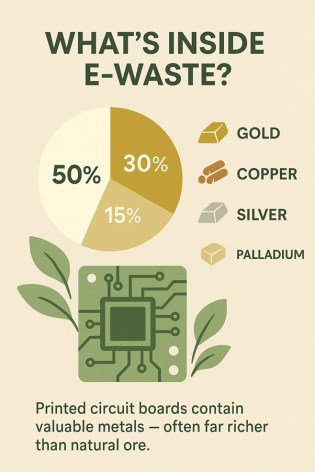

Research published in Waste Management found gold content ranging from around 180 to 3,700 mg per kilogram of PCB waste.

At an industrial scale, one tonne of circuit boards produces about 165 grams of gold on average, according to reporting on The Royal Mint’s operations in The Manufacturer. That’s roughly 30 times richer than typical gold ore – and that’s before you account for the copper, silver and palladium also present.

This isn’t theoretical potential. The Royal Mint opened a precious metals recovery facility in South Wales in 2024, capable of processing up to 4,000 tonnes of circuit boards annually.

Media coverage of the facility indicates that this volume of material contains roughly 0.5 tonnes of gold, 1,000 tonnes of copper, 2.5 tonnes of silver, and 50-60kg of palladium. The recovered gold is refined to 999.9 purity and is already being used in the Mint’s 886 luxury jewellery collection.

What makes this significant isn’t just the value recovered, but what it replaces. Historically, much of the UK’s end-of-life circuit board material has been exported to overseas smelters for high-temperature processing.

The Royal Mint’s approach, using room-temperature chemistry developed by Canadian firm Excir, extracts precious metals in minutes rather than hours and with considerably lower energy requirements.

The carbon calculation

The environmental case for proper e-waste processing extends far beyond preventing hazardous materials from entering landfills. The carbon savings from material recovery are substantial and well-documented.

Using copper scrap instead of virgin ore typically saves around 85% of the energy and cuts associated CO2 emissions by about 65%, according to the European Copper Institute and related industry data. For aluminium, recycled production can save about 95% of the energy and reduce emissions by around 90% or more compared with primary production.

Across common metals used in electronics, recycling consistently delivers very large energy and carbon savings versus mining and refining virgin material.

Applied at scale, these savings become significant. Research conducted by Anthesis and Lancaster University for Material Focus found that if the UK’s discarded small electrical products were properly recycled rather than thrown away or hoarded, we could avoid an estimated 2.8 million tonnes of CO2 emissions every year.

That’s roughly equivalent to taking 1.3 million cars off the road. The saving comes not from the recycling process itself, but from avoiding the energy-intensive extraction and processing of new raw materials.

These benefits can be amplified further when recycling operations themselves are powered by renewable energy.

ITAD facilities running on solar or other clean energy sources reduce the carbon footprint of the recycling process to near zero, meaning almost all the environmental benefit flows through to the avoided emissions from virgin material extraction.

It’s a compounding effect that makes the case for proper e-waste processing even stronger.

What we’re currently losing

Despite the value sitting in our discarded electronics, the UK’s collection infrastructure captures only a fraction of what’s available.

Defra data show that in 2023 the UK collected 473,019 tonnes of household WEEE against a target of 471,942 tonnes – the first time overall collection targets had been met since 2016.

That 473,019-tonne figure represents roughly one-third of the 1.45 million tonnes of electrical waste estimated to arise annually.

The remaining material follows less desirable paths. The Material Focus Electrical Waste challenges and opportunities research identified at least 500,000 tonnes of electricals being lost each year through being thrown away, hoarded, stolen or illegally exported, including around 155,000 tonnes of household electricals thrown in general waste and ending up incinerated or landfilled.

E-waste that reaches landfill does not simply sit there benignly. Electronic equipment can contain hazardous substances, including lead, mercury, cadmium and brominated flame retardants, which can leach into soil and groundwater over time if not properly managed.

Meanwhile, the embedded metals and plastics – which required significant energy and emissions to produce – are effectively written off.

Beyond precious metals: Critical materials

The conversation about e-waste value often focuses on gold and copper, but critical materials are an increasingly important part of the story. Hard disk drives contain neodymium-iron-boron magnets.

Electric vehicle motors use neodymium, praseodymium and dysprosium. These rare earth elements are essential for technologies ranging from smartphones to wind turbines.

According to the Global E-Waste Monitor 2024, only about 1% of global rare earth element demand is currently met through e-waste recycling. Most supply still comes from primary mining, which is heavily concentrated in a small number of countries.

Improving recovery of these materials from end-of-life products is therefore not only an environmental opportunity, but a strategic one for supply chain resilience.

While industrial-scale rare earth recovery from e-waste is still an emerging field, UK research and industry are moving fast. Universities and companies are advancing hydrometallurgical processes, magnet-to-magnet recycling and other ‘urban mining’ approaches.

As demand for critical materials grows with the energy transition, secondary recovery from e-waste is likely to become a core part of the supply picture, not a niche.

The business perspective

For organisations managing regular IT refresh cycles, the hidden value in e-waste translates directly to the bottom line. Proper IT asset disposition (ITAD) doesn’t just manage compliance risk; it can generate meaningful financial returns through asset value recovery.

A well-structured ITAD programme captures value at multiple stages: refurbishment and resale of functional equipment into secondary markets, component harvesting from non-functional units, and materials recovery from genuinely end-of-life assets.

Crucially, the data destruction needed for regulatory compliance happens regardless. When organisations work with certified ITAD providers, they often find that disposal costs can be significantly reduced – and in some cases offset entirely – by the value of recovered assets and materials.

The key is working with processors who can demonstrate transparent, auditable chains of custody. For UK IT equipment, that typically includes ISO 27001 certification, providing assurance around information security management across the process, and Environment Agency licences for waste carrier, broker and treatment activities, confirming legal compliance for WEEE handling and transport.

These credentials matter not only for compliance, but for ensuring that equipment and materials actually reach proper reuse and recovery channels – rather than being exported into informal processing or disappearing into residual waste streams.

A circular opportunity

The UK’s position as one of the world’s highest e-waste generators per capita is often framed purely as a problem. It is a problem – but it is also a resource opportunity. Every discarded laptop, every obsolete server, every broken smartphone contains materials that are genuinely valuable, both economically and environmentally.

The infrastructure to capture this value is continuing to develop. The Royal Mint facility in South Wales is one high-profile example of domestic recovery capacity. At the same time, ITAD providers, producer compliance schemes and authorised treatment facilities across the UK are investing in improved collection and processing.

Defra figures indicate that 2024 household WEEE collections increased further to around 496,000 tonnes, building on the progress made in 2023.

What’s needed now is broader recognition that e-waste isn’t simply a waste stream to be managed at least cost – it’s a resource stream to be captured and optimised. For businesses, that means treating IT asset disposal as part of a circular technology strategy, not just a line item under ‘waste’.

For the resources and waste sector, it means continuing to strengthen the collection networks, treatment capacity and market mechanisms that keep these materials in productive use.

The value hidden in e-waste is significant. The carbon savings from recovering it are measurable. The alternative – continuing to mine virgin materials while sending recoverable resources to landfill or low-grade recovery – makes neither environmental nor economic sense.

About the author: Jack Cartwright is Sales Director at Innovent Recycling, an ISO 27001-certified IT asset disposal and WEEE recycling company based in Cheshire. Innovent helps businesses across the UK manage end-of-life IT equipment with full data security compliance and environmental responsibility.

The post The hidden value in e-waste: The importance of proper IT asset disposal appeared first on Circular Online.

Packaging EPR

John Twitchen FCIWM, founder of Stuff4Life and Chair of CIWM’s Producer Responsibility Sector Expert Group, uncovers how EPR is having the unintended consequence of driving investment into commercial reuse and refill iniatives.

In October, the British Retail Consortium published research that showed over 80% of retailers plan to pass on the cost of the new packaging Extended Producer Responsibility (EPR) to consumers.

This led many to question if packaging EPR charges are set to just become ‘another inflationary pressure’ or is this the time of maximum opportunity? Or, to put it another way, what are the positive and/or unintended consequences for innovation and better consumer value for money, which reduce the cost on society?

Back to the future

The CIWM Presidential Report I authored in 2017, ‘Digital Technology and Consumer Trends’, for then President Professor Margaret Bates outlined growing evidence that UK packaging rules and the prospect of Deposit Return Schemes (DRS) – although at the time all talk of this was hushed – were creating unintended consequences shaping business behaviour.

Rising compliance costs, uncertainty over scheme design, and operational burdens were prompting retailers and brands to explore alternatives to conventional single-use systems – with an unintended consequence of driving some producers to using flexible, composite packaging and away from 100% recyclable materials.

This uncertainty, however, accelerated interest and investment in refill and reuse trials across grocery, personal care and online retail.

While several pilots showed strong consumer engagement and real potential for packaging reduction, inconsistent funding, operational complexity and policy delays continued to limit scalability. Overall, policy pressure was potentially driving innovation, but uncertainty undermined market adoption.

My report predicted that refill initiatives were likely to grow as the likelihood of EPR and DRS became unavoidable, pushing retailers to redesign packaging strategies. The most viable growth was predicted to come from automated, pre-filled or closed-loop models integrated into existing retail operations.

However, widespread adoption was predicted to depend on stable policy signals, shared infrastructure and consumer-friendly convenience.

And here we are now, eight short years, one pandemic and five Prime Ministers later.

Scio nescio: I know that I know nothing

There’s clear, documented evidence that the UK’s move to packaging EPR and the planned DRS is already changing behaviour – sometimes in unintended ways – including accelerating commercial interest and investment in reuse and refill models.

The UK EPR consultation and government analysis explicitly recorded respondents’ concerns about unintended consequences, such as loopholes, cost shifts, market complexity.

Written submissions to Parliament from industry representatives point to specific risks, like glass return bottlenecks, material substitution, DRS complexity, and also describe industry interest in alternative approaches, such as reuse and refill to manage risk.

Meanwhile, research has identified logistical problems, like collection/return, sorting capacity, for some materials that could reduce the practical effectiveness of DRS. A commercial response is to trial refill/reuse models to avoid or simplify returns.

Despite the UK EPR system currently lacking specific binding reuse targets like those proposed in the EU’s packaging regulations, WRAP and other bodies have published guidance and case studies specifically about mainstreaming refill and increasing citizen participation.

Meanwhile, retailers and industry groups are running trials to scale refill and reuse, projects framed as ways to reduce exposure to EPR/DRS costs and complexity.

And surely that’s the point – shifting to using less stuff. Scope 4 is the new cool!

Big retailers commit to reuse and refill

In 2025, nine major UK grocery retailers signed a joint Statement of Intent to explore reuse, and multiple retailers have run refill pilots – a market response consistent with firms hedging regulatory risk and seeking to avoid paying higher EPR and DRS costs.

Sector analyses have warned of perverse outcomes – for example, deposit designs encouraging smaller single-use containers, or material substitutions increasing environmental harm – which in turn push producers and/or retailers to consider packaging redesign, refill or reuse as mitigation.

And investors (e.g. Closed Loop Partners) have backed reuse/refill enterprises internationally, with those business cases informing UK pilots and commercial interest.

The future is bright

Here are eight UK refill and reuse pilots which demonstrate action by retailers and brands to test systems and products, customer engagement and service development.

Who

What

Outcome

1. Ocado — online reusable packaging pilot (Aug 2024) 

Two-phase online scheme (reusable vessels for staples, such as rice and pasta) run with the UK Refill Coalition, designed specifically for home delivery.

Launched as the first major online grocer pilot and progressed to phase-two trials – positioned as an ongoing test rather than a full roll-out.

2. Tesco x Loop — in-store reusable packaging trial (Sept 2021 — reflections 2022) 

Loop reusable container system in ten Tesco stores (customers bought products in durable containers and returned them to store).

Strong initial customer interest and operational learning; Tesco published lessons from the trial but the wider Loop model struggled to scale in the UK.

3. Unilever — refill trials including Asda Leeds (2020-2021) 

‘Return on the go’ and in-store refill trials (laundry/personal care brands) including a large Leeds refill zone.

Uptake exceeded expectations in Leeds (weekly purchases of refill products outperformed packaged equivalents), prompting expanded trials — positive commercial signal.

4. Asda — Middleton/Leeds sustainability concept store (2020-2024) 

Sustainability store with c.15 refill stations offering dozens of staples (2020 pilot).

Early trials showed customer interest but Asda scrapped or refocused refill store trials citing commercial/operational challenges (announced 2024).

5. Waitrose ‘Unpacked’ refill shops (2019-2022)

Waitrose trialled ‘Unpacked’ refill shops across multiple locations offering loose goods and refill options.

Reported sales growth (c. 9% uplift in refillables in an early period); later ended specific Unpacked pilots, noting learnings and planning further initiatives.

6. Co-op x Unilever — convenience format refill trials (2021)

Co-op worked with Unilever on small-format refill pilots in convenience stores to study consumer behaviour.

Pilots ran to test convenience-store dynamics; Co-op has continued targeted recycling/reuse trials (+ other returns trials e.g. coffee-pod collection).

7. Aldi x Refill Coalition trials (2023-2025)

Refill Coalition pilots (own-container dispensers in stores, with Aldi hosting trials in Solihull and Leamington Spa).

Trials demonstrated operational feasibility and customer interest, but Innovate UK funding withdrawal led to schemes being wound down in 2025.

8. Sector-level efforts and coalition activity — mixed longevity (2021-2025)

UK Refill Coalition and industry collaborations launched multi-retailer trials and projects (including a planned ‘world’s biggest’ multi-retailer trial).

Delivered significant learning and some successful short-term uptake; coalition funding/scale constraints meant several initiatives wound down by 2025 — showed pilots are hard to scale without long-term investment.

Government efforts

Despite the disappointing news that the Circular Economy Taskforce report has been delayed until 2026, and with nothing forthcoming on the long-promised EPR roadmaps for textiles, batteries and e-waste, the UK Government has issued an update to the Environmental Improvement Plan, which includes interim 2030 waste reduction targets.

The Act states that by 31 December 2042, the total mass of residual waste (excluding major mineral waste) ‘must not exceed 287kg per capita’ (c. 50% reduction from 2019 levels).

The November 2025 update sets out new interim targets that must be met by December 2030, including reducing residual municipal waste to ≤ 333kg per capita (c. 29% reduction), including specific targets for plastic waste (≤ 42kg, c.45% reduction) and glass (≤ 7kg, c. 48%).

Achieving this level of reduction is going to need significant change rather than just tinkering. However, because the targets are for residual waste left over after recycling, they don’t target true, substantial and meaningful waste prevention – they can be achieved by more recycling, which can, of course, lead to negative unintended consequences set out above.

What does this all mean?

Policy design risks – scope, deposit levels, materials included – create uncertainty and operational burdens for producers/retailers, who respond by testing alternatives such as refill, reuse, and packaging redesign.

Investor signals (retailer statements, WRAP guidance, external investments) show real commercial momentum behind refill/reuse, both as a sustainability strategy and as a hedge against EPR/DRS costs.

The many UK reuse and refill trials (examples listed in the table) show companies reacting ahead of full policy implementation by testing alternative models to reduce packaging and minimise future exposure.

Practical bottlenecks, such as collection, sorting, capacity, make DRS and large-scale recycling harder in the short term, encouraging pilots of refill systems that avoid takeback infrastructure.

These are examples of largely ‘unintended consequences’ in the sense that the policy isn’t just increasing recycling but is shifting business strategy towards reuse/refill – a welcome side-effect… as predicted.

And because reuse and refill models carry different costs and operational structures (return logistics, cleaning/refilling, consumer behaviour changes, stickier customers), their growth can become a new area of investment, innovation and infrastructure – an indirect effect of EPR and DRS policy.

In practical terms, more reuse/refill schemes mean the UK will import less stuff, and instead create economic activity – jobs and servitisation opportunities – in the domestic market, paying UK tax.

On the back of both my 2017 report and last year’s ‘EPR of everything, starting with batteries’ it shows that the role of the simple, humble measures like the right to refill and right to repair could have substantial impacts not just on the amount (and nature) of residual waste, but – much more importantly – on consumer and taxpayer value for money.

So the polar opposite of ‘another inflationary pressure’.

John Twitchen FCIWM is the founder of circular economy disruptor Stuff4Life and author of two reports for CIWM, ‘Digital Technology and Consumer Trends’ (Margaret Bates) and ‘EPR of Everything… Starting With Batteries’. John also chairs the CIWM’s Producer Responsibility Sector Expert Group.

The post How pEPR is driving investment into reuse and refill appeared first on Circular Online.

WRAP

Sebastian Munden, Chair of the global board of trustees for the climate action NGO WRAP, has been awarded a CBE in the King’s New Year Honours.

Munden, who is also Chair of the advertising industry’s climate action programme Ad Net Zero, was honoured for services to Business and the Circular Economy.

Sebastian Munden said: “This is an incredible honour. I’d like to pay tribute to my former colleagues at Unilever for over three decades of developing new products together, without whose inspiring partnership none of this would have been possible.”

“And to my current colleagues at WRAP and Ad Net Zero, working with businesses to make the circular economy an everyday reality across many different sectors.”

Munden is the independent Chair of the advisory steering group for Pack UK – the scheme administrator for UK household packaging recycling (Extended Producer Responsibility).

The group, which represents industry sectors, all home nations, and local authorities, has been giving wide-ranging input to Pack UK during the set-up of the scheme.

Before becoming Chair of WRAP and Ad Net Zero, Munden worked for over 30 years in consumer products. He was also chief executive of Unilever UK & Ireland for five years until 2022, and before this, as head of Unilever’s global marketing operations.

He has also served on policy and steering groups for The Food & Drink Federation, The Institute of Grocery Distribution, The Inclusive Economy Partnership run by the Cabinet Office, and Movement to Work, and chaired a policy review on the Future of the Local Economy for the British Chambers of Commerce.

Catherine David, CEO of WRAP, commented: “Sebastian has been instrumental in reshaping how businesses think and act, helping move the circular economy from the margins to the mainstream and demonstrating how business, government and industry can work together to deliver meaningful change at scale.”

“I’m thrilled to see Sebastian recognised for his outstanding contributions, including his leadership as Chair of WRAP, and it’s been a privilege to work alongside him in turning bold ideas into lasting change.”

As Chair, WRAP says Munden has helped the organisation establish WRAP Americas, WRAP EU and a more global way of working.

Commenting on the award, Munden said: “It’s also recognition for all those in the grocery industry working to create a better packaging system, and for the practical contribution of businesses alongside national and local governments in the way change is implemented.”

“It’s a joy to work alongside so many people who want to innovate a better future that’s also better business, with the circular economy growing in value much faster than the economy as a whole.”

The post WRAP Chair Sebastian Munden awarded CBE in New Year Honours appeared first on Circular Online.